The Lawsuit
Victory for Public Records! And an ongoing fight for even more data
In May 2025, the New York State Court of Appeals -- the highest court in New York -- ruled in favor of the non-profit organization Reclaim The Records in the long-running state Freedom of Information Law (FOIL) suit that we had brought against the New York State Department of Health (NYS DOH). The DOH was ordered to release their extracted data set to historical New York death records, more than ten and a half million records covering the years 1880 to 2017. These records are now freely available to the public for the very first time.
The Court of Appeals also ruled that the NYS DOH must finally provide to a judge a list of all other already-indexed data fields that they possess, and the specific years for which they have each field, so that those additional fields could potentially also be disclosed to Reclaim The Records, and thereby to the public. These fields may include other relevant information, such as the deceased person's full date of birth, place of birth, marital status, veteran status, parents' names, parents' places of birth, and possibly even more. As of December 2025, that "in-camera review" process of disclosure and argument in favor of some or all of the additional data fields is still ongoing.
The Story
The Data We Fought For
The New York State Department of Health has maintained a comprehensive death index since 1880, containing basic information about every person who died in New York State (excluding New York City for most years). This database includes names, dates of death, locations, ages, and certificate numbers for over 10 million deceased individuals spanning nearly 140 years of New York history. In fact, the state is required by law to create such an index and update it every year, in part so that it can regularly send out lists of recently-deceased residents to their local boards of election, to make sure their names would be stricken from the active voter rolls.
Important note about geographic coverage: New York State has a two-tiered system for vital records. Both modern and historical deaths that occur in New York City are generally handled and maintained by the New York City Department of Health and Mental Hygiene (NYC DOHMH), while deaths everywhere else in the state fall under the purview of the New York State Department of Health (NYS DOH). This means that the data we sought and won generally does not include most New York City death records.
However, there are some important caveats and exceptions. The first of those is "pre-consolidation" death data from places that are today in New York City. Kings County (Brooklyn), Queens County, Richmond County (Staten Island), and much of the Bronx didn't become part of New York City until 1898. Before that, those counties and neighborhoods within them, some of which used to be independent towns, reported their vital events to the state, in Albany, and may therefore be included in the state index.
Secondly, three major New York State cities -- Albany, Buffalo, and Yonkers -- didn't start reporting their local deaths to the state until around 1915, so some of their information is still housed with their city clerks, not with the state DOH. And even in the mid and later twentieth century, we've found tens of thousands of deaths from New York City and even out-of-state deaths still being reported in the 'New York State' death index, possibly because NYC or out-of-state residents may have died while within the State, or vice versa, and so some of their data wound up in the State index anyway.
Why This Data Matters
The NYS DOH had already published a small portion of this data online -- the index to death records from 1957 to 1970 -- on their own agency's open data portal. According to their own website metrics, this "Genealogical Research Death Index" was the second most-viewed dataset in their entire open data portal out of nearly 600 datasets, viewed even more often than COVID testing data and second only to Medicaid provider information. This overwhelming public interest demonstrated the enormous need for access to historical death records, even if it was just the basic names and dates index.
But that 13-year window (1957-1970) was just a fraction of what the DOH actually possesses. They had indexes covering nearly 140 years of deaths -- from the 1880s through the present day -- locked away in their internal systems. And many years of that index, especially in more recent decades, had far more fields of data extracted into the index than were ever published before. While actual state death certificates do have legal restrictions on their access, these basic index files did not. Why should the public only have access to 13 years of index data, and with limited fields of data, when the state held so much information spanning three centuries?
The FOIL Request and Denial
On November 11, 2021, we submitted a Freedom of Information Law request to the Department of Health, asking for "one complete set, in digital form, of the New York State Death Index, covering all data that is already retained by [DOH] in textual or database format, for all available dates through December 31, 2017, inclusive." We made clear that we weren't requesting actual death certificates, just the basic index data that DOH already maintained, and in fact was required to maintain.
On February 15, 2022, the DOH denied our request. They handed over one single year of data — 1971 — and told us to use their website for the 1957-1970 data they'd already published. For everything else? Denied. They cited Public Officers Law §87(2)(a) and Public Health Law §4174(1)(a), claiming the records were "specifically exempted from disclosure by state or federal statute" and arguing that release would constitute an "unwarranted invasion of personal privacy."
Think about that for a moment. They were claiming privacy concerns for basic textual index data about people who had died in the state in 1972. In 1940. In 1900. In 1880! People who have been dead for more than 50 years, over 100 years, even over 140 years. Meanwhile, they would happily sell anyone a copy of the actual death certificate from those same years -- a certificate which contains far more information than the basic index data we requested.
The Lawsuit
We appealed administratively. The Department of Health's Appeals Officer denied our appeal, doubling down on their privacy and statutory exemption claims. So on July 21, 2022, we sued the largest government agency in the state of New York.
With our attorney Michael Moritz -- himself both a lawyer and a genealogist -- we filed an Article 78 petition in the Albany County Supreme Court. Our argument was straightforward: DOH failed to meet its burden under FOIL. The requested records don't fall within any statutory exemption. There's no reasonable privacy expectation for deceased individuals, especially those who died generations ago. And disclosure of the data serves compelling public interests, which the agency had failed to discuss or interact with at all.
We pointed out the absurdity: DOH freely provides actual death certificates for anyone who died more than 50 years ago, which contain parents' names, spouse's name, cause of death, burial information—far more sensitive than the basic index we requested. Yet they claimed privacy concerns prevented them from releasing just the names and dates?
We also demonstrated that all of New York's neighboring states -- New Jersey, Connecticut, Massachusetts, and many others across the country -- already make similar death index data freely available online, often for much more recent years, without any reported increase in identity theft or fraud. We even cited New York's own previous assertions, obtained under a previous FOIL request, that they had no documentation ever tying a case of identity theft to an actual vital record, nevermind an index of data points taken from a vital record.
The Battle Through the Courts
The Department of Health fought back hard. They filed lengthy memoranda arguing that the records were exempt, that disclosure would facilitate identity theft (of dead people?!), that they'd have to create new databases (they wouldn't -- they already maintained these indexes internally, and we provided proof to the court that this was so), and that vague privacy concerns outweighed any public interest.
We responded with our own comprehensive legal briefs and supporting evidence. Our board member Alec Ferretti, a professional genealogist, submitted an affidavit explaining how DOH's own records inventory confirmed they maintained death indexes for all the requested years, how other states successfully provide this data without privacy issues, and how even the Director of the National Association for Public Health Statistics and Information Systems (NAPHSIS) had stated that "there's really no data that supports privacy issues and/or fraud is inhibited more in a state that has closed records than in a state with open records."
The state Supreme Court ruled in our favor, ordering disclosure of the records. But in New York, the Supreme Court is actually the name of the lowest level court. The Department of Health appealed our win to the Appellate Division, which reversed in a 3-2 decision, siding with the state. But in New York, a 3-2 split means that our case would automatically be taken up to the Court of Appeals, New York's highest court. We would be one of the only state Freedom of Information Law (FOIL) cases the Court of Appeals would hear that year, and a ruling on our case would affect much more than just the specific index records we sought, but would also impact the legal landscape for public records law statewide.
As the case reached the Court of Appeals, we received crucial support from two friends-of-the-court briefs. Professional genealogists Debra Braverman and Roger D. Joslyn filed a brief explaining how access to death index data is essential for estate proceedings in Surrogate's Courts, potentially saving families "incalculable money and time." The Justice Committee filed a brief connecting this case to government transparency more broadly, arguing that allowing vague privacy claims to shield public records would undermine accountability and public safety.
And you can watch our attorney Michael Moritz argue the case here!
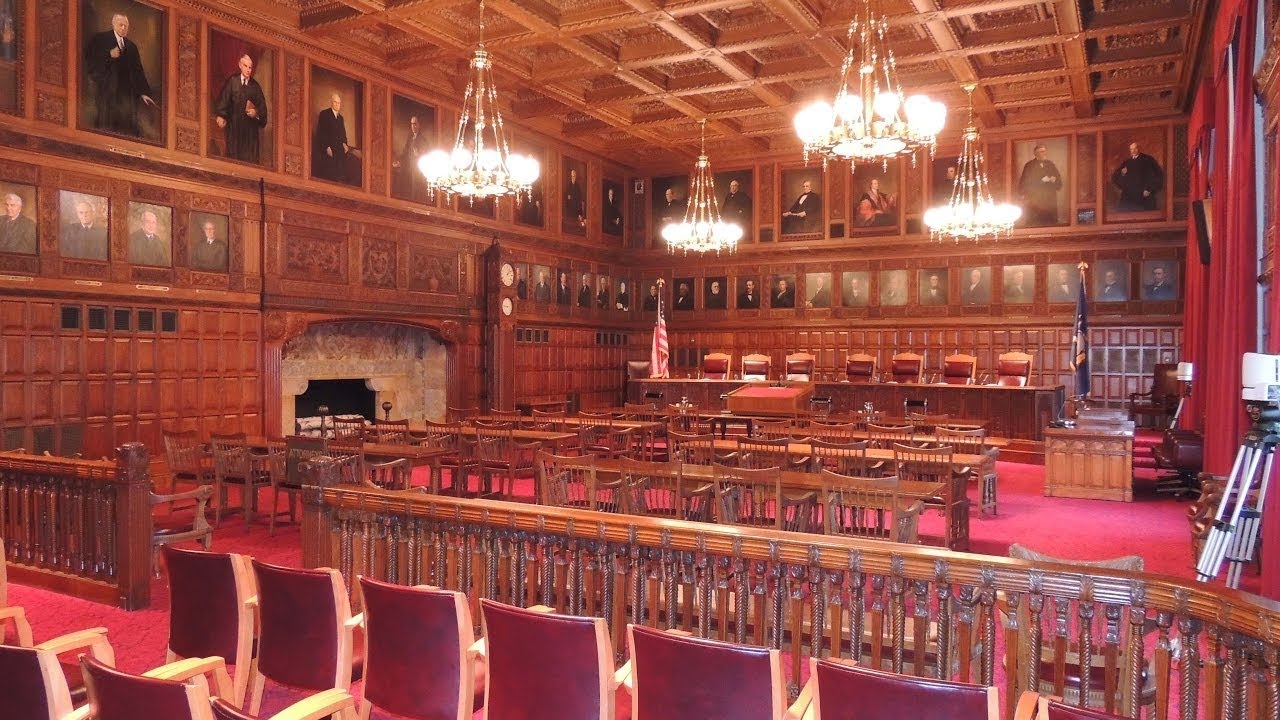
Victory
On May 25, 2025, the New York State Court of Appeals ruled in our favor. In a detailed opinion, the Court held that DOH must disclose death index records for 1973 through 2017 containing "decedents' first and last names, middle initials, dates of death, ages at death, genders, state file numbers, and residence codes"—the same fields DOH already published for 1957-1972.
The Court was clear: "The public interest in disclosure of these death index records outweighs the privacy interest in withholding this information, only to release it at a future date chosen by DOH." The Court rejected DOH's statutory exemption arguments, noting that Public Health Law only protects certified death certificates, not indexes. It rejected DOH's privacy claims as conclusory and unsupported by evidence.
We beat the largest government agency in New York State in the highest court in New York to win the first-ever publication of this data.
What This Means
The data you can now search on this website represents that victory. As we promised in our original announcement: "We'll clean the data, build search tools, and as always, publish every last line in free, downloadable, reusable formats."
Every record is freely searchable, downloadable, and usable by anyone—genealogists researching family histories, historians studying demographic trends, journalists investigating stories, estate attorneys locating heirs, pension funds preventing fraud, and families simply wanting to learn about their ancestors. No restrictions, no paywalls, no gatekeepers. Just as it should have been all along.
But Wait, There's More! (Well, Maybe)
The New York State Court of Appeals acknowledged that not once in the four year legal case, which by then had come before three different courts in the state, had the NYS DOH ever stated for the record exactly which types and fields of data it held for which years of the state index. It is generally believed that the state has extracted many more fields of data from death certificates into its copy of the index, at least for more recent decades, including (probably) the deceased person's date of birth (instead of just the estimated year, based on age at death), place of birth, marital status, spouse's name, parents' names, parents' places of birth, veteran status, and more.
The Court of Appeals stated it this way in their Order: "On the record before us, it is unclear which additional categories of information are contained in the records DOH maintains, and we cannot determine the extent to which disclosure of that information might constitute an unwarranted invasion of personal privacy. We therefore remit this matter to Supreme Court to conduct an in camera review and to consider DOH's assertion that this remaining information is exempt from disclosure in its totality, or whether certain portions are subject to redaction. Of course, DOH may only redact portions of records if it shows with particularity and specificity that a FOIL exemption applies..."
In other words, many more fields of data and types of data may be available for public release, after the NYS DOH and our attorneys conduct an "in-camera review" of the existence of those fields before a judge at the Supreme Court, back where the case first started. As of early December 2025, we and our attorneys are still awaiting our court date to argue for the potential release of these "extra" data fields.
Legal Timeline
Follow the progression of our case from initial FOIL request through the final Court of Appeals decision.
Initial FOIL Request
November 2021 - February 2022
Our first attempt to obtain the death records through a standard Freedom of Information Law request.
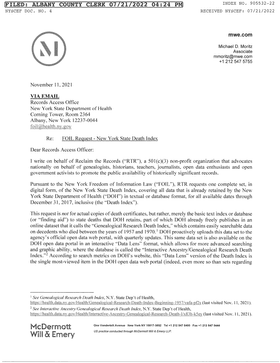
Original FOIL Request to NYS Department of Health
Our initial Freedom of Information Law request to the New York State Department of Health, asking for the complete death index database.
RTR requests one complete set, in digital form, of the New York State Death Index, covering all data that is already retained by [DOH] in textual or database format, for all available dates through December 31, 2017, inclusive.
This request is not for actual copies of death certificates, but rather, merely the basic text index or database to state deaths that DOH retains.
RTR is willing to pay for the time and effort needed to make this data available, including all costs related to data analysis and export, purchasing hard drives, and the insured and trackable shipping of the hard drives.
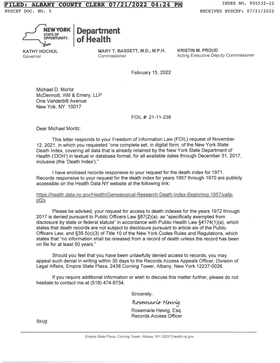
FOIL Denial by NYS Department of Health
The Department of Health's denial of our FOIL request, citing privacy concerns and claiming the data was not required to be released.
Your request for access to death indexes for the years 1972 through 2017 is denied pursuant to Public Officers Law §87(2)(a), as "specifically exempted from disclosure by state or federal statute" in accordance with Public Health Law §4174(1)(a).
Article 78 Litigation
July 2021 - January 2023
After our FOIL request was denied, we filed a lawsuit in New York State Supreme Court to compel the release of the records.
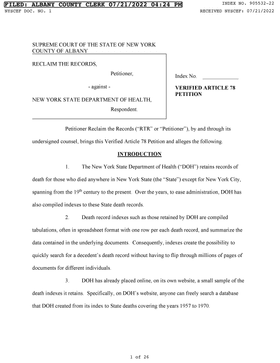
Article 78 Petition
Our formal legal petition filed in New York State Supreme Court to compel the release of the death index records under FOIL.
DOH has no legal basis to restrict access to New York State death indexes. As a New York agency, DOH had the burden of demonstrating with specificity why production was exempted under FOIL, but it failed to meet its burden.
There is zero logic in denying access to indexes of pre-1972 death records based on privacy when anyone can order all of the actual full and unredacted death certificates themselves from the very same agency.
Death indexes offer support to, among others, pension funds and insurance companies dealing with unclaimed property or potential benefits fraud; attorneys and genealogists tracing heirs for probate cases; and journalists, historians, statisticians and educators, who need access to data to accurately check sources and news stories.
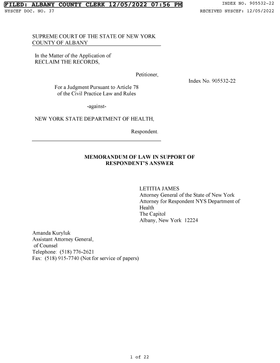
DOH Memorandum of Law
The Department of Health's legal arguments opposing the release of the death records.
The disclosure of the requested death records would constitute an unwarranted invasion of privacy under POL §87(2)(b). Such an unwarranted invasion of privacy outweighs any interest of public access when considering the personal information enclosed within the records.
The release of death indexes less than 50 years old, which contain social security numbers, dates of birth, and other personal information would constitute an unwarranted invasion of the personal privacy of a decedent's immediate survivors and survivors-in-interest.
There is a material difference between providing access to individual records on a demonstration of need and providing 50 years' worth of recent death indices to publish on the internet.
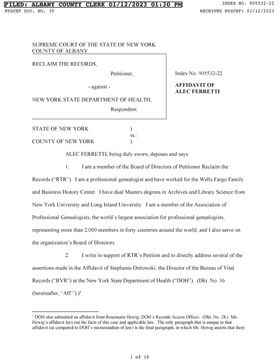
Affidavit of Alec Ferretti
An affidavit from genealogist Alec Ferretti explaining the importance of death records for genealogical research and how similar data is already publicly available.
Death indexes are generally public throughout the country. Generally, these types of indexes are publicly available and readily accessible online.
New Jersey's death index is now public through the year 2017, Connecticut's online death index actually contains far more data through the year 2012, and Massachusetts has an online death index through the year 2003. The results of this study are obvious: DOH is acting at odds with a significant number of states in raising privacy concerns.
There's really no data that supports privacy issues and/or fraud is inhibited more in a state that has closed records than in a state with open records. (Quoting Shawna Webster, Director of the National Association for Public Health Statistics and Information Systems)
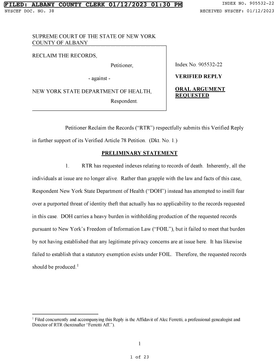
RTR Memorandum of Law
Our comprehensive legal brief arguing why the death records should be released under New York's Freedom of Information Law.
FOIL does not bar disclosure of personal information. Instead, FOIL puts the burden on agencies to establish that the disclosure of records would constitute an unwarranted invasion of personal privacy.
DOH has not met its burden because it did not adequately establish that the information sought--all of which relates to deceased individuals--would unduly invade anyone's privacy.
If certain data about living individuals is routinely made public (such as voter data), and if federal agencies such as the SSA and the VA routinely release biographical data about deceased Americans, then the release of the same basic data for deceased individuals in New York cannot constitute an unwarranted invasion of privacy.
Appeals & Amici Support
March 2025
The case progressed through the appeals process, with multiple organizations filing friend-of-the-court briefs in support of public access.
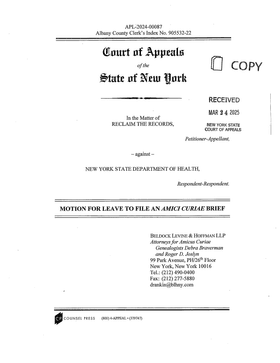
Amici Curiae Brief - Professional Genealogists
A friend-of-the-court brief filed by professional genealogists Debra Braverman and Roger D. Joslyn supporting the public release of these historical records.
In the probate context... my work requires me to demonstrate adequate proof that deceased individuals who would have been eligible under the law to inherit from an estate are, in fact, dead... A public database indexing basic death information would help immensely and would save the estate incalculable money and time.
When such a person died in one of the numerous states with open records laws, such as Massachusetts, Connecticut, or Florida, the process of locating records is much easier, faster, and cheaper for the estate, resulting in better outcomes for the families involved. In New York, if the person died more than 50 years ago, I can sometimes find data in the indexes on the DOH website... However, for people who died within the last 50 years, this is not an available option.
Providing open public access to an index containing up-to-date data on the names, ages, dates of death and locations of death would be a significant benefit to the thousands of New Yorkers who each year enter into estate proceedings in the Surrogate's Courts.
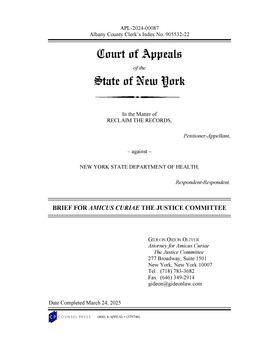
Amici Curiae Brief - The Justice Committee
A friend-of-the-court brief filed by The Justice Committee, a grassroots organization dedicated to ending police violence, supporting government transparency and accountability. Learn more
In enacting FOIL, the New York Legislature expressed the importance of government accountability and transparency in no uncertain terms, noting that "the more open a government with its citizenry, the greater the understanding and participation of the public in government."
Where government agencies are permitted to withhold records based on vague and unsubstantiated privacy concerns, communities face greater hurdles in holding their local law enforcement accountable for police misconduct and abuse.
Lack of transparency erodes the trust between law enforcement and the communities who have been systemically harmed by police violence, which in turn undermines public safety.
Court of Appeals Victory
May 2025
The New York State Court of Appeals ruled in our favor, ordering the Department of Health to release the death index records to the public.
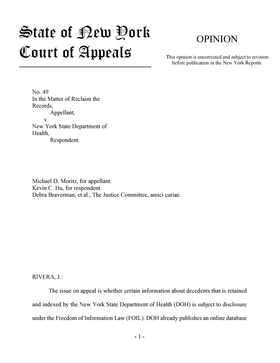
Court of Appeals Decision
The final decision from the New York State Court of Appeals, ruling in our favor and ordering the release of the death index records.
We agree with petitioner that DOH must disclose for those years [1973-2017] the same fields of information that are already part of the online database: decedents' first and last names, middle initials, dates of death, ages at death, genders, state file numbers, and residence codes.
The public interest in disclosure of these death index records outweighs the privacy interest in withholding this information, only to release it at a future date chosen by DOH.
As to deaths from 1973 to 2017, DOH has not shown that any exemption applies to the same categories of information that it publishes online for deaths from 1957 to 1972, and it must therefore provide those records to petitioner.
Learn More About Our Work Fighting for Free Public Records
Original Case Announcement
Read our detailed newsletter announcement about this case, including the full timeline, background context, and what the data contains. We published this when we first filed the lawsuit and updated the case for our subscribers as the case progressed through the courts.

Our Main Website
Discover our other Freedom of Information lawsuits across the country. We've successfully liberated millions of historical records from government agencies in New York, New Jersey, Connecticut, Missouri, Maryland, and more—all made freely available to the public. Learn about our ongoing cases, view our project wishlist, and see the records we've already published.
Support Our Mission
Lawsuits are expensive. Building websites like this one take time and resources. We're a small 501(c)(3) nonprofit funded entirely by donations from people like you. Help us continue fighting to liberate historical records from government agencies and make them freely available to everyone -- no paywalls, no restrictions, no gatekeepers, just free and open data!
